Welcome to the Pacific Northwest Coast! "An Eagle's Quest" story coming soon!

Create FUN Circle and Calendar Times
Tips and tricks to plan and implement successful circle times with Grandma Connie F Hovey’s nature story-poems and songbooks. Whether you are gathering a lively classroom of elementary students, a circle of preschoolers, or a few little ones at home, these simple ideas will turn routine transitions into moments of pure wonder.
Grandma Connie F Hovey
6/17/20262 min read
Create FUN Circle and Calendar Times
Tips and Tricks to Plan and Implement Successful Circle Times with Young Children
Bringing a group of energetic young children together on the rug can sometimes feel like trying to herd butterflies. If your circle time has felt a bit chaotic lately, take a deep breath—you are not alone, and it doesn't take a miracle to fix it. It just takes a little bit of play!
As a former preschool teacher, my secret weapon for a successful circle time has always been simple: active engagement. Children don’t want to just sit and listen; they want to participate.
Here are my top favorite teacher tips to transform your circle and calendar times into the most joyful, interactive part of your day.
Be Prepared Have a clear plan and your transition cues ready before you ask children to come to the rug. Use age appropriate stories and songs that are repeated often.
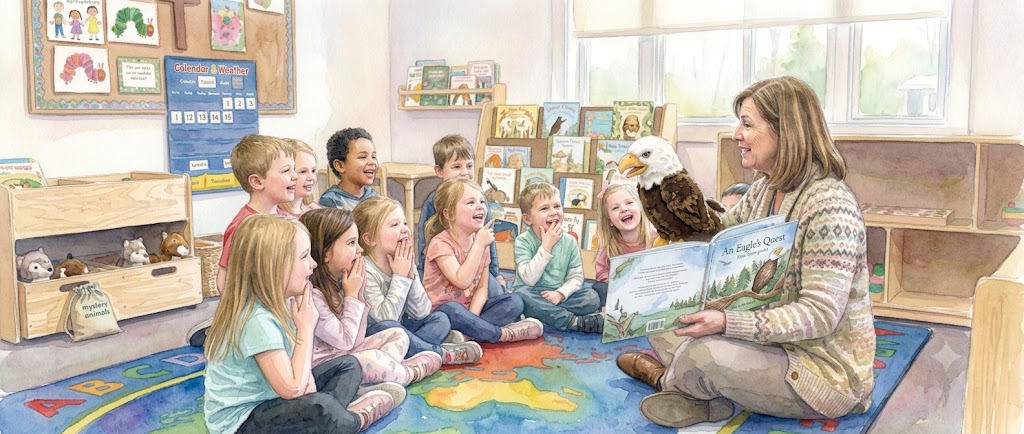
The Circle Basket Keep a dedicated basket filled with props, felt pieces, and puppets right next to you. Pulling a physical object out of a "mystery basket" instantly hooks young eyes.
The Mystery Fabric Bag: Drop a few small, familiar toys—like little plastic animals, wooden trees, figures—into a small, soft fabric bag. Call one child up at a time to reach their hand inside without looking. Once they pull a toy out, ask them an open-ended question: "Tell me about what you found!" This builds language skills, sensory awareness, and while the rest of the rug completely mesmerized waiting to see what comes out next.
Be Flexible Follow the energy of the room. If the children are restless, pivot to a quick body movement song or shorten the story. Connection always matters more than the schedule.
Engage the Children Give them jobs to do! Stop and ask questions. Let children hold a prop, point to a badge, or guess what comes next so they are active participants rather than just passive listeners.
Use Different Voices Bring the text to life by shifting your tone. Use sad, happy, whispered, or excited voices to create dramatic contrast that keeps early readers completely mesmerized. Enjoy yourself!
Use Rituals Start and end with the exact same familiar song or rhyme every single time. Predictable routines signal to a child's brain that it is time to ground themselves and focus.
Puppet Helpers: Keep a puppet (maybe a friendly forest creature!) hidden in your basket. The puppet can be the one who "whispers" the calendar date to you, or the one who looks around the circle to see who is ready to sing the next song.
Rhythm Instruments: Pass out simple egg shakers or rhythm sticks. Give them clear boundaries: "When the music stops, our shakers go to sleep in our laps." Use them to tap out the syllables of the weather or the rhythm of your morning song.
Grandma Connie
Story Time
Contact
Stay Connected
Hello@grandmaconniestorytime.com
© 2026 All rights reserved.